BIM is increasingly becoming a global requirement across the construction industry, especially for large-scale public, infrastructure, and commercial projects. Regions such as the Middle East, Europe, and the USA are seeing stronger adoption of BIM standards and digital delivery practices, creating huge career opportunities for skilled BIM professionals. In 2026, as countries move toward complex workflows, model-based design coordination, data-driven construction, cloud collaboration, AI-enabled automation, and international BIM standards such as ISO 19650, students with real project exposure and internship experience will have a clear advantage in both local and global job markets.
For beginners, this shift can feel confusing. Many students and young professionals ask: “Where should I start if I want to build a career in BIM?” The answer is simple: do not start by learning every software at once. Start by understanding how BIM is used in actual projects.
The right BIM training or BIM course should help you move beyond tool commands, develop an overall understanding of an actual project life cycle, and understand how digital models support planning, design, construction, coordination, and project delivery. This guide explains how beginners can build a clear career path in BIM across roles such as BIM Modeler, BIM Engineer, BIM Coordinator, BIM Specialist, BIM Lead, BIM Manager, VDC Engineer, Digital Delivery Coordinator, and BIM Consultant. These skilled BIM professionals are now in demand across architecture, engineering, construction, infrastructure, MEP, structural design, façade and steel fabrication, precast detailing, modular construction, facility management, and digital twin-based asset management. As BIM adoption grows across global markets, students with the right training and real project exposure can prepare for careers in multiple industries connected to the built environment.
1. Understand What BIM Really Means
BIM is not just about creating 3D models. Model creation is only one part of a much larger information management process. At its core, BIM involves creating, organizing, managing, sharing, and coordinating digital project information across the entire building lifecycle. This includes design data, construction details, schedules, quantities, documentation, asset information, and facility management data, helping teams make better decisions from planning and design to construction, handover, and operations.
In a real project, BIM connects architects, structural engineers, MEP teams, contractors, consultants, and sometimes facility managers. A good BIM model is not just visually correct. It should contain proper levels, grids, families, sheets, parameters, quantities, and discipline-specific information.
This is why companies now look beyond basic modeling skills. They want candidates who understand how models support design coordination, clash detection, cost planning, scheduling, documentation, and construction execution.
2. BIM Training Should Cover All Trades and Then Focus on One Discipline
Good BIM courses will help beginners understand how all the different trades, like Architecture, Structural, Mechanical, and Façade Design, fit together so that they understand a typical workflow in a project.
This is them followed by a focus on one discipline. For example, civil engineers may begin with a BIM for Architectural and Structural course or BIM for Façade Design course; mechanical or electrical engineers, meanwhile, may begin with a BIM for MEP course.
At the beginner level, recruiters do not expect you to know everything. They expect discipline clarity. Your first goal should be to understand levels and grids, views and sheets, families and components, documentation, model organization, naming conventions, and discipline-specific modeling logic.
Good BIM training should help you build this foundation before moving into interdisciplinary coordination.
3. Learn BIM Software Properly, Not Just Quickly
Tools like Revit and AutoCAD are important tools for BIM beginners. However, learning them should not mean memorizing commands or watching random tutorials. You need to understand why a model is created in a certain way.
For example, a wall may carry information about type, material, thickness, fire rating, cost, and quantity. Similarly, a duct or pipe may affect ceiling height, structural clearances, and coordination with other services.
At the foundation stage, you should know the many things to do and not do. Focus on clean modeling habits. Avoid downloading random families without understanding parameters, file size, naming, or model performance. A beginner’s model should be clean, structured, and easy to review.
4. BIM Courses Must Include Documentation
Once you understand basic modeling, the next step is documentation. Many beginners focus only on the 3D model and ignore drawings, sheets, schedules, and revisions. But in real projects, BIM models must support deliverables.
A job-ready BIM beginner should understand how to create proper sheets, manage views, prepare drawing sets, apply annotations, create schedules, and export documentation. This is where your model becomes useful for project teams.
Recruiters often reject CVs that mention only “Revit modeling.” Instead of writing “Worked on Revit,” it is better to say that you created architectural models, prepared sheets, generated schedules, or supported drawing documentation for a specific project type.
This is why BIM courses should not stop at modeling. They should teach how models are converted into usable project outputs.
5. Understand LOD and Model Quality
LOD, or Level of Development, explains how much detail and information a model should contain at different project stages. An early design model may not need the same level of detail as a construction-ready model.
Beginners do not need to master every advanced LOD requirement immediately. But they should understand the basic idea. Model quality is not about adding unnecessary detail. It is about providing the right level of information for the as per project requirement.
Poor BIM models can create real project issues with real-world impacts. Wrong levels, duplicated elements, missing information, incorrect families, and unclear naming can lead to coordination errors, rework, and delays.
This is why BIM careers grow faster when professionals learn model quality from the beginning.
6. Learn Clash Detection and Coordination
The next major step is coordination. This is where BIM becomes more than individual modeling. In real projects, architectural, structural, and MEP models must work together. If an HVAC duct passes through a structural beam, or if a pipe clashes with a ceiling element, the issue must be identified before construction.
Tools like Navisworks are commonly used for clash detection. Beginners do not need to become advanced coordinators immediately, but they should understand the purpose of clash detection, model review, issue tracking, and coordination meetings.
This is especially important for those planning to work in India, the UAE, Saudi Arabia, Qatar, or other global AEC markets. Many projects now expect BIM professionals to understand coordination workflows, not just modeling tasks.
7. Learn Common Data Environment Workflows
Modern BIM projects are increasingly cloud-based. Teams often work through Common Data Environment (CDE) platforms such as BIM 360, Autodesk Construction Cloud, or Autodesk Forma. These platforms help project teams collaborate, manage models, drawings, issues, revisions, and approvals in a shared digital space.
This shared space is often called a Common Data Environment, or CDE. Beginners should understand how files are uploaded, reviewed, revised, and shared across teams. They should also understand why version control and naming standards matter.
In 2026, knowing how to model is the baseline. Knowing how to work inside a structured BIM workflow is what makes a candidate more employable.
8. BIM Courses Should Help You Build a Portfolio and CV
A certificate can support your profile, but a portfolio and CV prove your ability. Many BIM beginners complete courses but struggle during interviews because they cannot explain what they have actually worked on.
A strong beginner portfolio and CV should include a few well-presented projects. Each project should mention the project type, discipline, software used, exact role, modeling scope, outputs created, and coordination exposure if any.
For example, instead of saying “Residential project done in Revit,” explain that you created an architectural BIM model, developed floor plans and sheets, prepared schedules, and followed basic naming and documentation standards.
Instead, write in a project-focused way: “Created discipline-specific Revit models, prepared drawing sheets, supported basic clash review in Navisworks, and followed structured file naming and documentation workflows.”
Project-based BIM courses are more useful than theory-heavy programs because they help learners build work samples that can be shown during interviews.
Your CV should show project readiness. Mention project types, deliverables, model responsibilities, coordination exposure, and documentation outputs. A focused CV with real skills is stronger than a crowded CV with unproven claims.
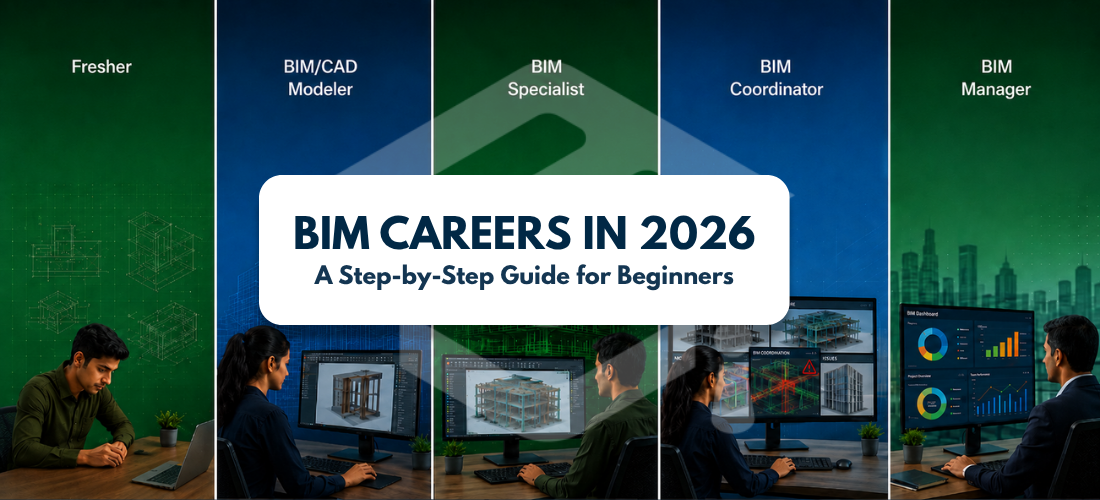
9. Understand the BIM Career Path
A BIM career usually grows in stages. Beginners should understand this path clearly so they do not feel lost.
A BIM Fresher focuses on software basics, discipline understanding, documentation, model accuracy, and workflow awareness.
A BIM Modeler creates discipline-specific models, prepares drawings, follows standards, and supports project documentation.
A BIM Coordinator focuses on clash detection, model review, issue tracking, coordination meetings, and communication between disciplines.
A BIM Lead manages a team or discipline-specific BIM workflow. This role involves task planning, quality checks, coordination support, and delivery responsibility.
A BIM Manager is responsible for BIM strategy, standards, BIM Execution Plans, client communication, team coordination, quality control, and digital delivery. This is not just a senior modeling role. It is a leadership role.
10. Future-Proof Your BIM Career with the Right BIM Training
BIM careers in 2026 are becoming more data-driven and lifecycle-oriented. Future roles will involve digital delivery, information management, cloud collaboration, sustainability coordination, 4D scheduling, 5D cost planning, and facility management.
This does not mean beginners need to learn everything immediately. But they should build the right mindset. Instead of asking, “Which software should I learn next?” ask, “Can I explain how BIM supports a real project?”
This is where structured BIM training becomes important. Good BIM training helps beginners understand not only how to use tools, but also how BIM connects with project planning, coordination, documentation, cost control, and long-term building management. It prepares learners to adapt as project requirements, software platforms, and industry standards continue to evolve.
Conclusion
BIM offers strong career opportunities for beginners in 2026, especially across India and international markets. But the industry now expects more than basic software knowledge. To grow in BIM, you need a clear learning path.
The right BIM training can help beginners learn BIM skills in a focused, structured and project-focused way. Well-designed BIM courses taught by experienced BIM professionals can bridge the gap between classroom learning and real project expectations. They also help learners stay prepared for the future by introducing them to coordination workflows, digital delivery methods, cloud-based collaboration, and emerging areas like 4D, 5D, and facility management.
The journey from BIM Fresher to BIM Manager takes time, but it becomes easier when you learn BIM the way the industry actually uses it. In 2026, the most successful BIM professionals will be those who understand how projects work digitally from start to finish.