Engineering graduation gives students a strong technical foundation. It teaches them how structures work, how building systems are designed, how drawings are prepared, and how construction projects are planned. But once graduates enter the professional world, they often realize that academic knowledge alone is not enough to meet industry expectations.
The Architecture, Engineering, and Construction industry is becoming more digital, coordinated, and data-driven. Companies are no longer looking only for graduates who understand drawings or basic design concepts. They need professionals who can work with digital project information, coordinate across teams, reduce errors, support faster delivery, and contribute to real construction workflows.
This is where BIM courses become highly valuable after engineering graduation.
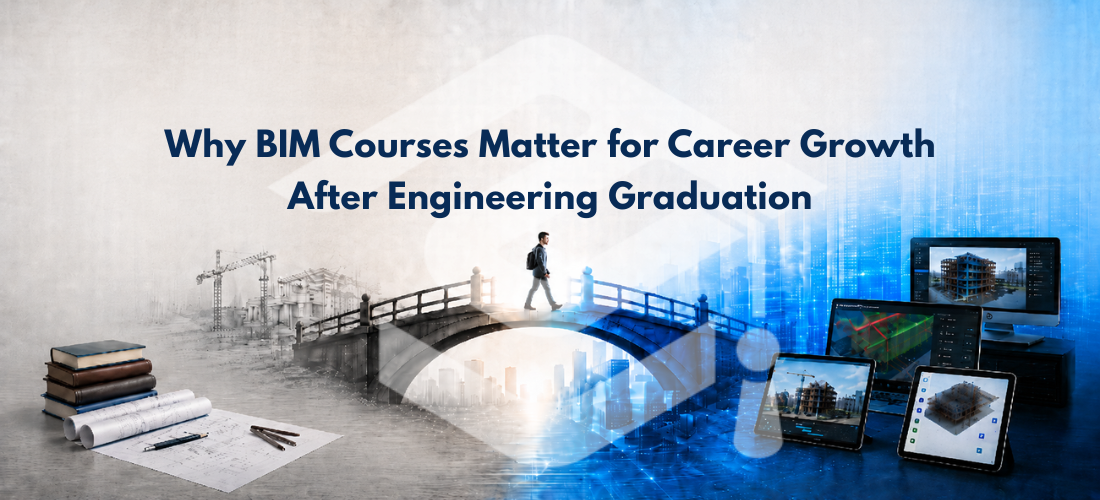
Building Information Modeling, or BIM, is not just about creating 3D models. It is a process used to create, manage, share, and coordinate project information across the lifecycle of a built asset. For engineering graduates, BIM creates a bridge between technical knowledge and the way modern construction projects are planned, designed, coordinated, built, and managed.
The Gap Between Engineering Education and Industry Expectations
Most engineering courses focus on core technical concepts. Civil engineering students learn structural design, surveying, estimation, construction materials, and project management. Mechanical and electrical students learn systems, calculations, design principles, and technical documentation. These subjects are important, but the industry also expects graduates to understand how real projects move from design to execution.
In professional construction projects, no discipline works in isolation. Architects, structural engineers, MEP engineers, contractors, consultants, fabricators, and project owners all work together. A duct may clash with a beam, a pipe route may interfere with a ceiling design, or a structural opening may be missing from the model. These issues can delay construction, increase cost, and create confusion on site.
BIM training helps graduates understand this coordination process. It shows how design information is developed, checked, shared, revised, and used by different stakeholders. This gives fresh graduates a stronger understanding of how projects are delivered in the real world.
It also helps engineering students use their technical background to understand how real-world BIM projects work with specialized courses: BIM for Architecture & Structure and BIM for Façade Design for civil engineers and architects; and BIM for MEP for mechanical and electrical engineers.
BIM Makes Graduates More Job-Ready
One of the biggest benefits of a BIM course after engineering is employability. Many fresh graduates have theoretical knowledge but limited exposure to professional tools and workflows. BIM courses help bridge that gap.
A good BIM course introduces students to industry-used tools such as Revit, Navisworks, AutoCAD, Autodesk Construction Cloud, Tekla, Civil 3D, or other discipline-specific platforms. However, software learning is only one part of the process. The real value comes from understanding how these tools are used in documentation, coordination, clash detection, quantity take-off, design review, and construction planning.
For example, a civil engineering graduate who learns BIM can move beyond reading 2D drawings. They can understand how architectural, structural, and MEP models come together, identify design conflicts, and support project teams with more accurate information.
BIM courses also build interview confidence. Instead of speaking only about academic subjects, graduates can discuss modeling workflows, coordination issues, drawing documentation, project standards, and the practical use of BIM in construction.
BIM Is More Than 3D Modeling
Many beginners think BIM means learning Revit or creating 3D building models. That is only a small part of BIM. Model creation is important, but BIM is more about information management.
A BIM model can include geometry, materials, specifications, quantities, schedules, asset information, cost data, and maintenance details. This information can support design decisions, construction planning, cost estimation, coordination, renovation, facility management, and asset operations.
A strong BIM course helps students understand this larger picture. It teaches them that a model is not just a visual output. It is a digital information source that supports better decisions across multiple stages of a project. This shift in thinking is one of the reasons BIM training matters so much after engineering graduation.
Learning BIM in a Professional Environment
The environment in which students learn BIM also matters. A course that is limited to classroom instruction may teach software commands, but it may not prepare students for how BIM teams actually work.
Learning BIM in an office-like setting gives students early exposure to professional workflows. They begin to understand how project files are organized, how deadlines are managed, how models are reviewed, how revisions are handled, and how coordination happens between teams. This helps fresh graduates understand the discipline and structure of a real workplace.
It also helps them build professional habits. They learn how to communicate clearly, follow instructions, maintain file naming standards, update models responsibly, document changes, and respond to review comments. These may seem like small things, but they are important in a professional BIM environment.
For engineering graduates, this exposure can make the transition from college to workplace smoother. They are learning not just software, but how to work like part of a BIM team.
Mentorship from Experienced Engineers
Another important factor in BIM career growth is mentorship. The best BIM courses are not taught only through textbooks or generic tutorials. They are guided by real engineers, BIM coordinators, BIM leads, or industry professionals who have worked on actual projects and understand the demands of the industry.
This matters because BIM is not just a design software skill. It requires engineering understanding. A structural BIM modeler must understand beams, columns, slabs, foundations, and load paths. An MEP BIM professional must understand duct routes, pipe systems, electrical containment, access space, and coordination requirements. A civil or infrastructure BIM professional must understand site conditions, utilities, alignments, quantities, and construction sequencing.
When students learn from experienced professionals, they understand more than button-clicking. They learn why certain modeling practices are followed, how coordination problems are solved, how drawings are checked, how project standards are maintained, and how teams communicate with clients and consultants.
This kind of mentorship exposes students to professional thinking, workflow planning, quality expectations, workplace discipline, and industry communication.
Real-Life Projects Improve Industry Readiness
Project-based learning is one of the most valuable parts of BIM training. Students understand BIM much better when they work on real-life project examples instead of isolated exercises.
Real project exposure helps students understand practical challenges such as revisions, coordination issues, incomplete information, deadlines, and discipline-specific requirements.
For example, while working on a project sample, a student may have to create a model, generate sheets, check clashes, update drawings, prepare quantity schedules, or coordinate with another discipline. This gives them a practical understanding of how BIM supports the construction process.
It also helps students build a portfolio. Instead of simply saying they have completed a BIM course, they can show sample models, drawings, coordination screenshots, clash reports, and documentation outputs. This gives employers more confidence in their abilities and helps fresh graduates speak with more clarity during interviews.
Career Options After BIM Training
BIM courses can open the door to several career paths after engineering graduation. A beginner may start as a BIM Modeler or Junior BIM Engineer, but with experience, they can move into roles such as BIM Coordinator, BIM Specialist, BIM Lead, BIM Manager, Digital Construction Engineer, or VDC Engineer.
These roles are relevant across construction, infrastructure, fabrication, facility management, real estate, industrial projects, oil and gas, data centers, healthcare, hospitality, and large commercial developments.
For civil engineers, BIM helps with structural modeling, rebar detailing, construction documentation, quantity take-off, site coordination, infrastructure modeling, and construction sequencing. For mechanical engineers, it creates opportunities in HVAC modeling, equipment placement, plant modeling, fabrication drawings, and clash detection. For electrical engineers, BIM supports lighting layouts, power distribution, containment modeling, cable tray routing, and coordination with other building systems.
This multidisciplinary nature makes BIM one of the most practical skill additions after graduation.
Global Career Opportunities
BIM skills are valued in many international markets because large construction projects increasingly depend on digital coordination, standardized documentation, and collaborative workflows. Regions such as the Middle East, Europe, the USA, the UK, Singapore, and Australia have strong BIM adoption across public infrastructure, commercial buildings, industrial projects, and large-scale developments.
This does not mean every graduate will immediately get an international role. But BIM training improves their readiness for companies that work on global projects. Many engineering and BIM service companies in India support international clients, allowing graduates to work on projects from the USA, UK, UAE, Saudi Arabia, Qatar, Australia, and other regions as part of global delivery teams.
BIM Supports Future-Focused Skills
The construction industry is moving toward digital delivery, automation, cloud collaboration, data-rich models, AI-supported workflows, and lifecycle asset management. BIM is one of the foundations for this transformation.
Future BIM professionals may work with 4D scheduling, 5D cost planning, digital twins, facility management data, sustainability analysis, prefabrication workflows, and AI-assisted model checking. A graduate who learns BIM early builds a strong base for these advanced areas.
This is important because career growth is not only about getting the first job. It is about staying relevant as the industry changes. A BIM course gives graduates a practical starting point for long-term professional development.
Conclusion
BIM courses matter after engineering graduation because they help students move from academic learning to professional project delivery. They improve job readiness, technical confidence, coordination skills, and career opportunities. More importantly, they help graduates understand how modern construction projects are designed, documented, coordinated, built, and managed.
For engineering graduates, BIM is not just an additional software skill. It is a career-building capability. It connects engineering knowledge with digital construction workflows and prepares students for roles that are increasingly important in the global AEC industry.
A graduate who learns BIM in a professional environment, receives mentorship from experienced engineers, and works on real-life project examples gains a clear advantage. They are better prepared for interviews, workplace expectations, and long-term career growth. With the right training and project exposure, BIM can become a strong foundation for building a successful career after engineering graduation.